
Hot tub biofilm
Hot tub biofilm forms a slimy layer of dirt, body oils and bacteria inside your pipes. Just shocking the water won't get rid of it. After adding a line cleaner and running the jets, drain the tub, rinse the jets, then refill.
- Inside most tubs, the pipe length totals 30 m
- More than 100 ft
- Line cleaner dose ahead of a drain (1 US pint, 473 ml)
- 1 pint
- Run the jets while the cleaner is in the water
- 1 hour
- How often should you purge the lines?
- Each time you drain
Where it grows and what it is
Leslie's calls it a mix of waste, oils, solids and bacteria. The pipe network reaching the jets in most tubs extends well over 100 feet (30 m). Since no one wipes the inside, a film builds up there.
It feeds on makeup, body oils and dead skin. When the pump stops, it sticks to pipe walls after settling where water moves slowly.
A tub can grow it while sitting unused, whether full or drained with water left in pipes. Biofilm grows fast in busy tubs that have weak sanitizer. Tubs with pool tablets, unbalanced water or old filters do too. A cheap used tub often serves as a source too.
Signs of hot tub biofilm
The film stays nearly too thin to see while young, so spotting it is hard. These indicators come from Leslie's plus the Hot Spring owner's manual.
- Look for slime inside the jets. Usually brownish, a thin, oily layer appears inside a jet you can take apart.
- Check a swab for odd colors. Rub a cotton swab inside the filter housing, the drain or a few jets while the tub is empty.
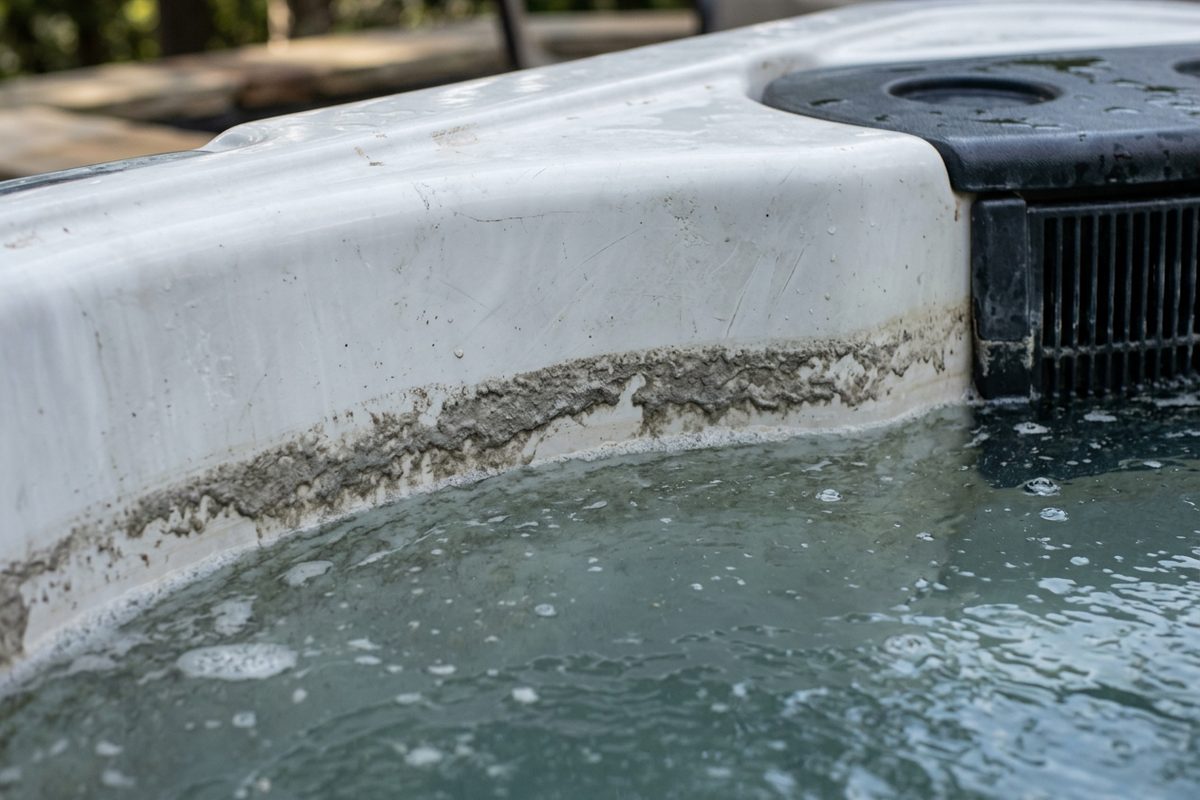
- Watch for a scum ring. Grime that keeps coming back appears behind the pillows or at the water line.
- Look for foam forming. Among its effects, Leslie's lists water problems and foaming.
- Your sanitizer vanishes. Chlorine or bromine gets consumed by biofilm, which also shifts the pH.
- A musty odor appears. Hot Spring ties the odor to algae or bacteria growing inside the tub.
Reasons chlorine fails to clear it
In the water, chlorine works on whatever it touches. Sanitizer that reaches it keeps getting used up by biofilm sitting on pipe walls where water barely moves past.
Usual chlorine or shock doses therefore only weaken it. The film settles back on the walls whenever the pump stops. Leslie's uses a purge cleaner to break the film apart in every hidden spot.
Steps to purge before draining
- Drop the pH and turn down the heat. Use pH down to reach 7.2 and turn off the heater, as Leslie's suggests.
- Apply a super shock treatment. Pour in 4 times your usual amount of non-chlorine shock. Severe cases might require extra. Your normal tub dose comes from the shock calculator.
- Put in the line cleaner. For instance, Leslie's points to Natural Chemistry's Spa Purge, which requires 1 US pint (473 ml). Add it and let the jets run for 1 hour.
- Drain the hot tub. Turn off the power first, then follow instructions on how to drain a hot tub.
- Rinse each jet with a hose. Spray inside every jet and any opening the nozzle fits, then drain that water as well.
- Install a fresh filter cartridge. Old pleats can trap bacteria deep inside.
- Fill up and balance the water. Add the startup chemicals in sequence, then restart filtering and sanitizing.
Stay out of the water while line cleaner is present. Do not combine it with other chemicals in any bucket or cup.
What it means when hot tub water smells
| Smell | Likely cause | Fix |
|---|---|---|
| Strong chlorine | Chloramines, the used chlorine, or low pH | Shock, then raise the pH to range |
| Musty | Bacteria or algae growing | Shock; if it stays, purge, drain and refill |
| Stale or dirty | Low pH, too much body waste, or low sanitizer | Shock, add sanitizer, fix the pH |
The Hot Spring owner's manual contains the water troubleshooting table these rows follow. Hot Spring states that free chlorine, which is the active type, has no scent. A heavy pool odor indicates used chlorine, meaning your tub needs shock treatment.
Bromine tubs act differently. Hot Spring notes that used bromine lacks a sharp smell yet still destroys germs. Read more at bromine vs chlorine.
What causes a hot tub that smells like chlorine?
Chloramines cause a strong chlorine smell, not excess chlorine. The CDC notes that chlorine reacts with sweat, urine, and other body waste to create chloramines, a form of combined chlorine. These release the odor and may irritate eyes, skin, and noses.
Compare two pads on your test strips to check. To find combined chlorine, the CDC subtracts free chlorine from total chlorine, and most health departments limit public pools to 0.4 ppm (parts per million) or less for this value.
Shocking the water fixes the problem; adding more chlorine will not. The CDC states that shock breaks down chloramines by briefly raising chlorine well above normal levels. Leisure Time warns that adding extra sanitizer only creates more chloramines instead. Your dose comes from the shock calculator. Keep the cover off while the tub vents, and shower before soaking to prevent the smell from returning.
Why your hot tub smells musty
A musty smell means something is growing. Hot Spring recommends shocking the tub first, then draining, cleaning, and refilling if the odor persists or you see growth.
Check the pipes if the smell returns quickly after shocking. Biofilm matches that pattern; shock weakens it but does not remove it. Run the purge before draining so old water carries the slime away.
Cleaning the hot tub scum line: what to do
Grease at the water line forms a ring called a scum line. The Hot Spring owner's manual blames it on accumulated dirt and oils. Remove it by wiping with a clean rag. For thick buildup, Hot Spring drains the tub, uses a spa surface and tile cleaner on the shell, then refills.
Only use products made for spas and hot tubs, Leslie's says; never use household cleaners on the shell. To break down oils and keep scum rings from forming, it adds a spa enzyme once a week. A ring reappearing soon after wiping is a sign of biofilm too.
Keeping biofilm from returning
- Leslie's bases the 3 to 6 month water change rule on how often and how many soak, advising sooner changes for busy tubs.
- Run a line cleaner each time you drain the tub.
- Always keep the water balanced and the sanitizer within the proper range. Test the chlorine level before every soak.
- Apply shock after heavy use or twice monthly.
- Install a new filter cartridge every 12 to 24 months.
- Blow air through the pipes to dry them if you drain the tub and do not plan to refill it soon.
Common questions
Can hot tub biofilm cause illness?
Leslie's warns that it can trap harmful bacteria. It also consumes sanitizer, leaving less available to kill germs in the water. You must purge the system before soaking again.
How can I tell if my hot tub has biofilm?
Watch for brownish slime inside a jet, a recurring scum ring, foam, or a musty odor. Rapidly dropping sanitizer levels are another sign.
Does shock kill biofilm?
Shock makes it weaker, yet it won't remove it from the pipes. Running a line cleaner through the jets before draining will break it up.
How often should I add a hot tub line cleaner?
Do this each time you empty the tub. Do it at each water change, Leslie's advises, meaning every 3 to 6 months for most tubs.
Could a new hot tub contain biofilm?
Yes, because water remaining in the pipes after factory tests can allow it to form. Before shipping the tub, most good manufacturers now dry and sanitize the pipes.