
How to read hot tub test strips
Give hot tub test strips about 15 seconds and they read your sanitizer and alkalinity in ppm (parts per million), plus pH. Answer the three questions below and you will see what to add first.
You can see what to add, and in what order, by answering three short questions.
- Free chlorine (4 to 6 ppm if you use bromine)
- 3 to 5 ppm
- pH, with 7.2 to 7.8 still fine
- 7.4 to 7.6
- Alkalinity (total)
- 80 to 120 ppm
- Keep the strip flat before you read it
- 15 seconds
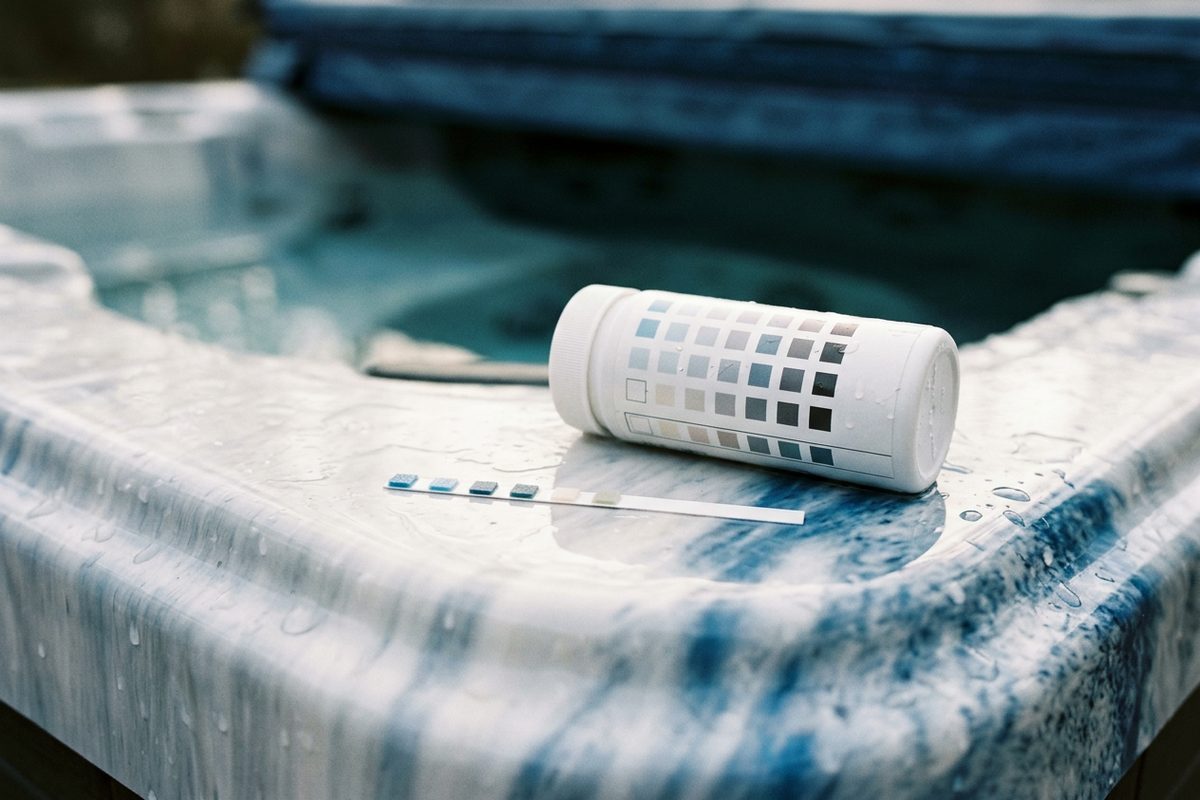
How to read hot tub test strips
- Place the strip in the water briefly. Put it in the tub water and pull it out immediately.
- Keep it flat with pads facing up for 15 seconds. Do not shake off extra water, per the AquaChek care guide.
- Compare the colors immediately. Put each pad right beside the chart printed on the bottle. Choose the value in between if a pad rests between two blocks.
- Record every pad result before adding any chemicals. One reading often explains another, so adjust them in order.
Right after a shock, a pad that shows no chlorine is often a false reading. According to CDC, chlorine over 10 ppm may bleach the pad, resulting in a false low or 0 ppm.
Meaning behind every pad
| Pad | Ideal range | Too low means | Too high means | Fix |
|---|---|---|---|---|
| Free chlorine | 3 to 5 ppm | Germs can grow | Over 5 ppm: do not soak | Chlorine level |
| Total chlorine | Equal to free chlorine | Below free: retest, the strip is off | Above free: used-up chlorine, so shock | Shock the tub |
| Total bromine | 4 to 6 ppm | Germs can grow | Over 6 ppm: lid off, stay out until it falls | Chlorine and bromine levels |
| pH | The range is 7.4 to 7.6, though 7.2 to 7.8 remains OK. | Sore eyes, corroded parts, sanitizer fades fast | Weak sanitizer, scale, cloudy water | Raise pH or lower pH |
| Alkalinity (total) | 80 to 120 ppm | pH drops and swings | pH stuck high, scale | Raise or lower alkalinity |
| Total hardness (calcium) | 150 to 250 ppm | Soft water eats metal parts, foam | Cloudy water, scale | Calcium hardness increaser, or a partial drain |
| Cyanuric acid | 0 ppm; drain above 100 ppm | Fine, 0 is the goal | Chlorine works more slowly | Partial drain and refill |
The Hot Spring owner's manual provides the pH band and its effects. The EPA-registered dichlor label provides the 5 ppm soak limit and alkalinity info. The bands for chlorine and bromine follow the AquaChek care guide.
Quantities to add depending on your tub size
| Strip reads | Add | 100 gal (380 L) | 250 gal (950 L) | 400 gal (1,510 L) | 500 gal (1,890 L) |
|---|---|---|---|---|---|
| pH 7.8 to 7.5 | pH down | 0.1 oz (2.8 g, about 0.5 teaspoon) | 0.25 oz (7 g, about 1.5 teaspoons) | 0.4 oz (11 g, about 2.5 teaspoons) | 0.5 oz (14 g, about 1 tablespoon) |
| pH 8.2 or higher to 7.5 | pH down | 0.2 oz (6 g, about 1 teaspoon) | 0.5 oz (14 g, about 1 tablespoon) | 0.8 oz (23 g, about 1.5 tablespoons) | 1 oz (28 g, about 2 tablespoons) |
| pH 7.2 to 7.5 | pH up | 0.13 oz (4 g, about 1 teaspoon) | 0.33 oz (9 g, about 2 teaspoons) | 0.52 oz (15 g, about 1 tablespoon) | 0.65 oz (18 g, about 1.5 tablespoons) |
| pH 6.8 to 7.5 | pH up | 0.37 oz (10 g, about 2 teaspoons) | 0.93 oz (26 g, about 2 tablespoons) | 1.5 oz (42 g, about 3 tablespoons) | 1.9 oz (52 g, about 3.5 tablespoons) |
| Alkalinity up 10 ppm | Alkalinity up | 0.22 oz (6 g, about 1.5 teaspoons) | 0.55 oz (16 g, about 1 tablespoon) | 0.88 oz (25 g, about 2 tablespoons) | 1.1 oz (31 g, about 2 tablespoons) |
| Alkalinity down 10 ppm | pH down | 0.34 oz (10 g, about 2 teaspoons) | 0.85 oz (24 g, about 1.5 tablespoons) | 1.4 oz (39 g, about 2.5 tablespoons) | 1.7 oz (48 g, about 3.5 tablespoons) |
| Free chlorine up 1 ppm | Chlorine granules (dichlor) | 0.02 oz (0.7 g) | 0.06 oz (1.7 g, about 0.5 teaspoon) | 0.1 oz (2.7 g, about 0.5 teaspoon) | 0.12 oz (3 g, about 0.5 teaspoon) |
| Weekly shock | Chlorine shock (dichlor) | 0.2 oz (6 g, about 1 teaspoon) | 0.5 oz (14 g, about 1 tablespoon) | 0.8 oz (23 g, about 1.5 tablespoons) | 1 oz (28 g, about 2 tablespoons) |
These numbers come from the same charts used by the hot tub chemical calculator, which calculates any other size. Keep the jets running, add one chemical, then wait 15 minutes before the next dose.
Spoon amounts are level kitchen spoons, as on the Leslie's chart: a teaspoon holds about 0.17 oz and a tablespoon about 0.5 oz. Powders settle, so weigh the dose when you have a kitchen scale.
First chemical to add
Start with alkalinity, follow with pH, then chlorine, per Lay-Z-Spa. Alkalinity keeps pH steady. Both must be correct before sanitizer works well.
Add one chemical at a time. Before the next dose, Leslie's has the water run for 15 minutes. Lay-Z-Spa requests at least 2 hours between different chemical types for its tubs. Use the chemical calculator for a single dose.
Pour chemicals directly into the water while the jets run. Do not ever combine two chemicals in a cup or bucket.
Hot tub pH level
Hot Spring sets the ideal hot tub pH level at 7.4 to 7.6, while CDC accepts 7.0 to 7.8. The agency notes chlorine kills germs less effectively as pH rises, especially above 8.0.
Hot Spring waits two hours after adding pH up or pH down before testing pH again. A reading taken earlier might be wrong.
Hot tub calcium hardness pad
The hardness pad measures mostly calcium, and Frog targets 150 to 250 ppm. Water below 150 ppm becomes corrosive and pulls calcium from metal parts. Levels above 250 ppm can cause cloudiness and scale in the pipes.
You can raise it with a calcium hardness increaser like calcium chloride. Only fresh water will lower it. Foam can result from low hot tub calcium hardness, notes the Intex PureSpa manual.
Hot tub cyanuric acid pad
Cyanuric acid, or stabilizer, protects chlorine from sunlight, but CDC advises against using it in hot tubs because it slows germ killing.
Dichlor granules add a small amount with each dose, Leslie's points out. This means a hot tub cyanuric acid reading climbs slowly over the weeks. The dichlor label sets a limit of 100 ppm. Drain and refill the tub once you pass that point.
Hot tub water testing: how often
Home owners are asked by CDC to test pH and chlorine at least twice a day. When several people use the tub, you should test more often. The Hot Spring manual advises testing before every use and adding nothing if levels match the target.
A DPD kit gets a higher accuracy rating from CDC, though strips are quick. For important hot tub water testing, like a confusing reading, confirm the result with a DPD kit before you dose.
Common questions
How long should a test strip stay in a hot tub?
Place it in the water and pull it out right away. Hold it level with pads up for 15 seconds, then match the colors without shaking off the water.
Can you trust hot tub test strips to be accurate?
For daily checks they are fine, but a DPD test kit is more accurate per CDC. If chlorine exceeds 10 ppm, the pad may bleach and show 0.
Why does total chlorine show a higher value than free chlorine?
Combined chlorine is the gap: chlorine that has already reacted with oils and sweat and stopped working. Shock the tub if total reads higher than free.
What is the first thing to correct on a test strip?
Start with alkalinity, move to pH, then handle chlorine or bromine. Alkalinity keeps pH steady, and sanitizer performs poorly until both reach the proper range.